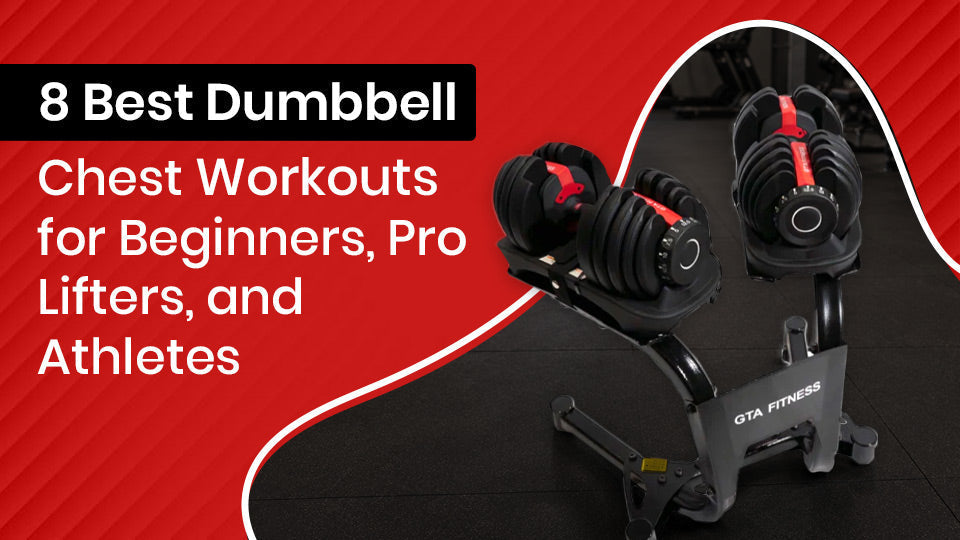

Building a bigger, stronger chest does not require a full gym, a barbell, or a spotter. All you really need is a pair of dumbbells and the right workouts to go with them.
Here’s why dumbbells actually outperform barbells for chest training: they give you a greater range of motion, force both sides of your chest to work equally, and let your wrists and shoulders rotate naturally, meaning less joint stress and more chest activation.
Below are the best 8 dumbbell chest workouts that cover every angle - upper, lower, middle, and inner chest. Walk through them and make your next chest day count.
8 Dumbbell Chest Exercises for Beginners
Incline Dumbbell Press
Most chest press exercises engage your upper chest, but this one, the incline dumbbell press exercise, targets your upper chest in a more effective way. How? It tilts your body slightly back, so when you push the weights up, your upper chest has to do most of the pushing, not your shoulders, not your middle chest, just the top.
How to do it:
- It’s simple, just set your bench to a low incline, typically between 20 and 30 degrees.
- Sit down, pick up a dumbbell in each hand and rest them on your knees
- Then lie back on the bench just like while doing a flat bench exercise and bring the dumbbells up to your chest level.
- Push the weights up and very slightly inward, like you’re pressing them toward each other without letting them touch
- Slowly bring them back down until you feel a stretch at the top of your chest, then push back up.
Here’s a tip: Don’t just think about pushing the weights up; think about pushing your upper chest towards the ceiling. That way, you can keep the focus more on the right muscle.
Mistake to avoid: If you set the bench too high, your shoulders will have to do the work rather than your chest, which can make the workout less effective.
Dumbbell Bench Press
Speaking about the dumbbell bench press, it’s a more effective chest workout exercise compared to its barbell counterpart. By doing it, you can achieve a greater range of motion without letting your wrists and shoulders get stuck in one position. And especially for people with shoulder or wrist issues, this is a much more comfortable way to train the chest.
How to do it:
- Pick up a dumbbell in each hand and sit on the edge of a flat bench, resting on your knees. Then lean back slowly until your back is flat on the bench
- Hold the dumbbells at your chest level, palms facing forward, and elbows bent at about 45 degrees.
- Push the weights up until your arms are straight, and slowly bring the weights back down
- Repeat the workout once you feel a good stretch across your chest
Tip for you: Keep your upper back pressed into the bench the whole time. If you notice a gap between your back and the bench, that means the weight is too heavy.
Mistake to avoid: Don’t bring down the weight too fast; at least take 2 to 3 seconds lowering it, that’s where your chest does the most work.
Dumbbell Floor Press
If you’re working out at home and you don’t have a bench, no problem - you can do this floor press exercise using a dumbbell. It’s also one of the most underrated chest exercises that you can do without a bench. Moreover, it’s great for people with some sort of shoulder injury as it prevents your elbows from dropping below your body.
How to do it:
- With a dumbbell in each hand, sit on the floor with your knees bent and feet flat on the ground
- Lean back until your back is flat on the floor, and bring the dumbbells up to your chest level
- Your upper arms will naturally rest on the floor, and that’s your starting position
- Push the weights straight up until your arms are almost straight
- Slowly lower them back down until your upper arms touch the floor again. Then pause for a second, and then push back up.
Tip for you: Don’t skip the pause at the bottom, as it stops you from using momentum and ensures your chest does the actual work.
Mistake to avoid: We’ve seen many trainees who make this common mistake of dropping their upper arms quickly onto the floor on the way down. This only results in lost rep benefit and chest muscles losing all the tension built up during the movement. The right way is to lower your arms slowly and gently, like you’re carefully placing something fragile on the table.
Dumbbell Fly
In the dumbbell fly exercise, you open your arms out wide and then bring them back together. That motion puts a deep stretch on your chest muscles that other exercises miss, making it a great addition to any chest workout.
How to do it:
- Lie back on a weight bench in flat or incline mode and hold a dumbbell in each hand.
- Slowly open your arm out to the sides, lowering the dumbbells in a wide arc until you feel a stretch across your chest
- Stop when your arms reach the same height as your shoulders, and don’t go lower than that, as this will put your shoulders in an uncomfortable position.
- Bring the dumbbells back together in a wide arc, squeezing your chest at the top
Tip for you: Keep your elbows slightly bent throughout the whole movement because keeping arms straight can put stress on your elbow joints.
Mistake to avoid: Don’t bring your arms too far down; stop when they reach shoulder level, because if you go lower than that, it can hurt your shoulders.
Dumbbell Fly-to-Press
If you had to pick one exercise that combines the best of two movements, this would be it. The dumbbell fly-to-press is exactly what it sounds like: you get into the fly form by lying on a flat bench, holding dumbbells in each hand, then open your arms out to the sides and bring them back up and right at the top. You don’t stop; instead, push the weights straight up like a regular press.
How do you achieve the two movements in one rep? Throughout the workout, the fly part stretches your chest wide open, and the press part pushes it to work even harder. That’s how it works.
How to do it:
- Lie flat on a bench, holding a dumbbell in each hand, and your arms pointing straight up above your chest,
- Slightly bend your elbows and gradually open your arms out to the sides, making a fly motion
- Then reverse the motion, bringing the dumbbells back over your chest.
- Now it’s time for the traditional chest press. Push the weights straight up toward the ceiling.
- That’s one rep - open out, return back, press up, and then repeat
Tip for you: Make sure you take a pause before switching to the chest press so your chest can do the work, not just your arms carrying the momentum
Mistake to avoid: Opening your arms too-wide can strain your shoulders and make the movement uncomfortable. So make sure to keep them in line with the bench.
Dumbbell Push-Up
Push-ups are already a solid chest training exercise, but when you do them with dumbbells, they become even better. That’s because when you place your hands on dumbbells instead of the floor, it raises your body slightly higher, which means your chest doesn’t hit the floor as quickly. You get a little extra room to go deeper on each rep.
How to do it:
- Place two dumbbells on the floor, matching your shoulder width - one dumbbell under each hand.
- Hold each dumbbell handle and get into a push-up position - arms straight, body in a straight line from your head to your feet.
- Slowly lower your chest toward the floor, going as far as you comfortably can
- Push yourself back up until your arms are almost straight
Tip for you: Keep your hands directly below your shoulder line to make sure pressure stays on your chest, not on your wrists
Mistake to avoid: While doing push-ups with a dumbbell, many trainees let their hips drop toward the floor as they get tired, but this puts all the strain on their lower back and stops the chest from working.
Dumbbell Decline Bench Press
This exercise is mainly for training your lower chest. It’s similar to the flat bench press; the only difference is that your head is slightly lower than your feet. That small change in angle shifts most of the work to the lower part of your chest.
How to do it:
- Set the bench to a decline, then lie back and lock your feet into the pads. Ask someone to place a dumbbell in each of your hands.
- Push the weights straight up toward the ceiling, then slowly bring them back down to chest level and repeat.
Tip for you: Don’t set the bench too far down; a slight tilt is enough for a comfortable position
Mistake to avoid: What many trainees do is they sit up immediately after completing their rep, which just results in feeling lightheaded or losing their balance. It’s not a great way to end a set. Always make sure to bring the dumbbells down to your knees first, then sit up slowly.
Decline Deficit Push-Up
This exercise is like a regular push-up but with two small upgrades. Your feet go up on something raised like a bench or a chair and you hold the dumbbells instead of placing your hands flat on the floor. The angle you make while exercising pushes more of the work onto your lower chest and the dumbbells under your hands let you go a little deeper than a normal push-up.
How to do it:
- Put two dumbbells on the floor, get into a regular push-up position and hold the dumbbell in each hand.
- Then place your feet up on a bench or chair
- Slowly lower your chest down below your hands and keep your back straight throughout the rep
- Push yourself back up to raise your body back to the starting position
Tip for you: During the rep, look down at the floor, not forward. This will keep your neck aligned with your spine.
Mistake to avoid: Many beginners go down only halfway and rush back up. But the whole point of using dumbbells here is to go deeper than a normal push-up. So take it slowly, lower all the way down until you feel your chest stretch, and then push back up.
Your Next Chest Day Starts Here
You now have all 8 Dumbbell chest workouts that cover your chest from every angle. You don’t have to do all of them in one session; just pick 3 or 4, focus on doing them well, and rotate through the others once you’re well into your routine.
And if you’re looking for high-performance, durable dumbbells across Canada, check out the GTA Fitness collection online. We carry adjustable dumbbells, twist dumbbells, hex dumbbell sets with stands, and more, giving you everything you need for your home or commercial gym.